
Crisis resilience: EUI-ESM Conference on Crisis Communication
In November 2025, the European University Institute (EUI) and the European Stability Mechanism (ESM) hosted a joint Crisis Communication Conference at the EUI’s School of Transnational Governance. I was invited to speak at this conference.
Communication as a Strategic Element of Stability
The city of Florence has long been a place where complexity gives rise to creativity – a fitting venue for a conference dedicated to crises, trust, and communication. The event gathered leaders, scholars, and practitioners from across Europe to discuss one the defining questions of our time: How can we communicate effectively and credibly in an era marked by uncertainty, complexity, and eroding trust?
As a consultant working in crisis communication and organizational change management, this topic is central to my everyday work. Participating in this forum – where experts and practitioners from public institutions and private organizations met on equal ground – was both valuable enrichment in terms of content and a reminder the power of peer exchange. When the conference day came to an end, the sense among many participants was that discussions had only just begun.
We live in a time when authority, data, and expertise alone no longer guarantee trust. People assess institutions and leaders not simply by what they say, but by how they say it – by their tone, pace, and responsiveness. The challenge for communicators, therefore, lies not in delivering perfect messages, but in maintaining relational credibility over time.
The conference at a glance
The conference opened with welcome remarks from Pierre Gramegna, Managing Director of the ESM, and George Papaconstantinou, Chair of International Political Economy at the EUI’s School of Transnational Governance. Both highlighted that in times of overlapping crises, communication is not peripheral – it is strategic. It shapes how institutions act, how decisions are interpreted, and how trust is maintained across borders.
The first keynotes from Professor Winni Johansen of Aarhus University and Professor Paul Argenti of The Tuck School of Business at Dartmouth emphasized just that: trust is the currency of modern communication. Without it, even the most sophisticated crisis response fails to resonate. Their talks explored how trust is built not only through factual accuracy but through consistency, transparency, and empathy – the ability of organizations to remain credible while acknowledging uncertainty.
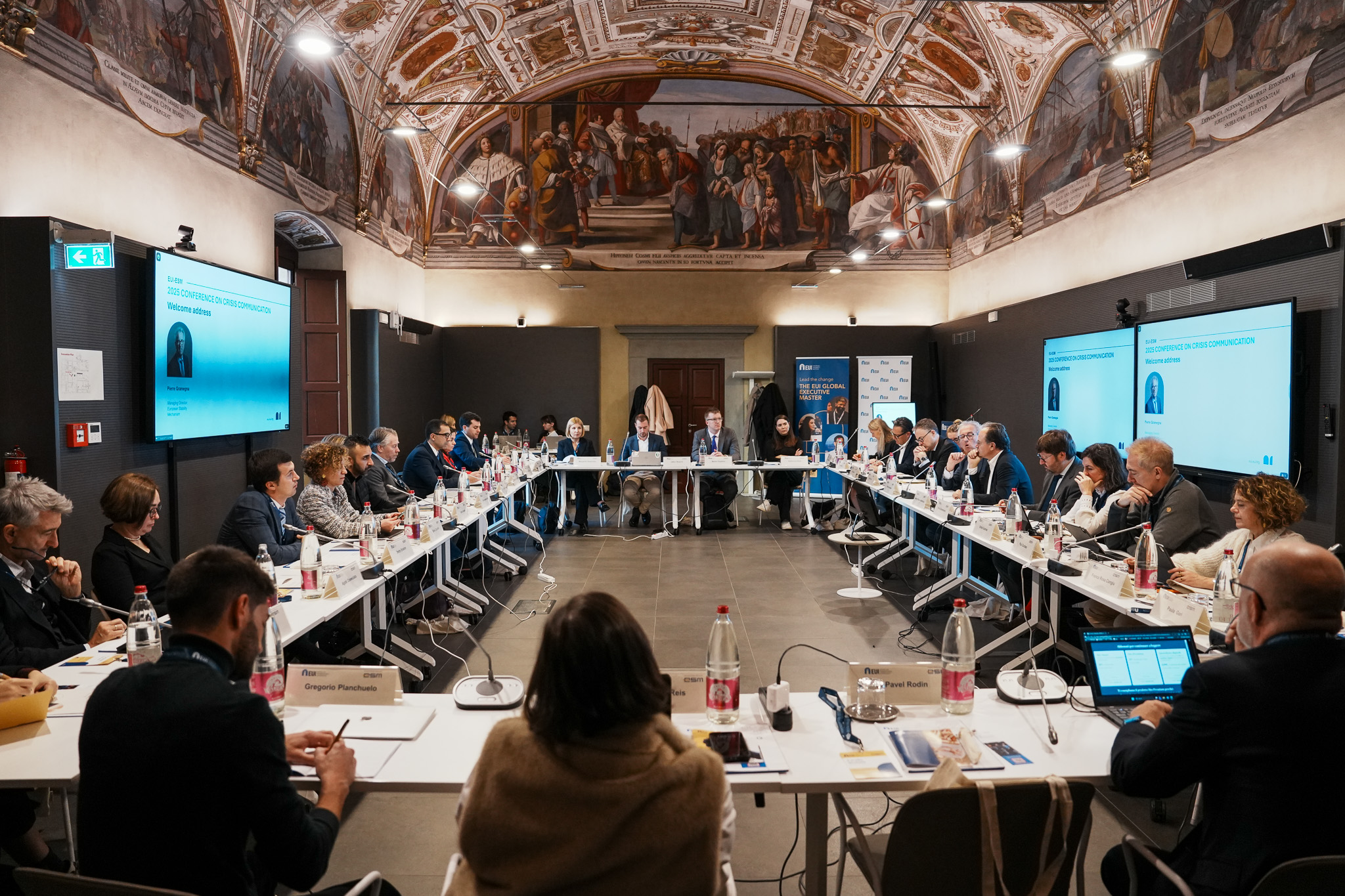 For me, several themes stood out:
The need to actively counteract the fundamental loss of trust in public authorities, the media, and institutions.
The conviction that communication is more than just information, especially in crises: we must engage, listen, and provide feedback.
The importance of time: When everything is moving faster and faster, the conclusion is not “we are even faster,” but “we consciously take this essential moment between stimulus and response.”
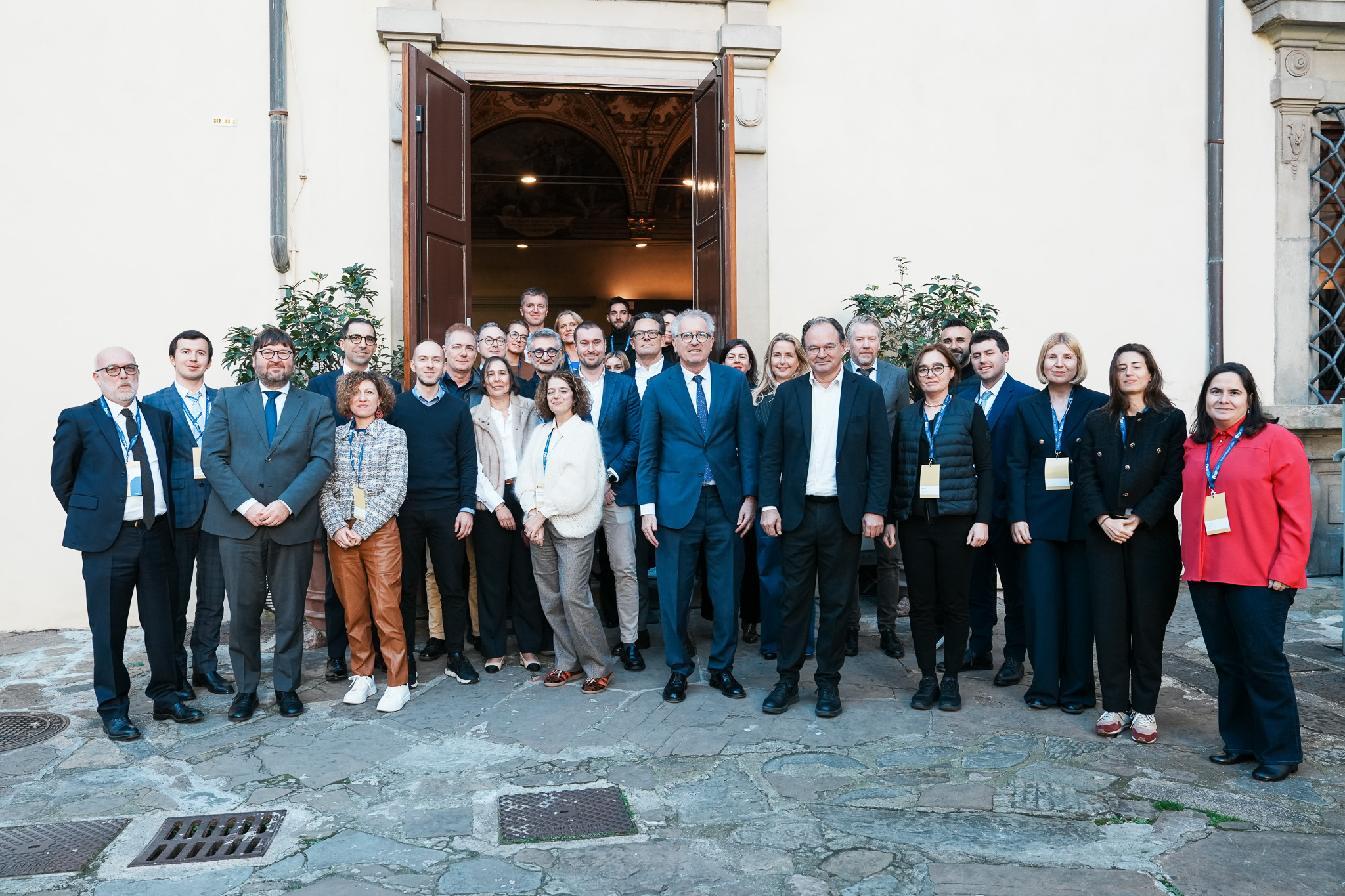 The Omnicrisis and the Evolution of Crisis Communication
When crises accumulate and interact, they become more than the sum of their parts. Climate change, geopolitical instability, economic volatility, digital disinformation, and institutional fatigue do not occur separately. They merge — forming what many now call the “omnicrisis”, a condition of multiple, interlinked disruptions that shape each other continuously.
This concept framed much of the discussion in Florence. In such a reality, traditional linear approaches to crisis management are insufficient. Predetermined response plans can help, but they cannot replace adaptive judgment and communicative agility. Here, the notion of strategic improvisation becomes crucial. It reflects the ability of institutions to act coherently and transparently even when new variables emerge faster than procedures can adapt.
During the discussions, many participants emphasized that communication in the age of the omnicrisis is less about control and more about coherence. When uncertainty dominates, what people look for is orientation. For communicators, the task is to create this orientation — through narrative clarity, credible leadership voices, and the consistent framing of context, even when answers remain incomplete.
Communication as a Vector of Resilience
Crises test not only systems but relationships. The conversations in Florence reminded all participants that communication is not just about informing — it is about connecting. Whether in government, finance, or industry, communication serves as the social fabric that holds cooperation together under pressure.
As a consultant for strategic crisis communication, I see this daily in organizations navigating transformation and uncertainty. The communication challenges of a financial stability mechanism, a government, or a multinational company may differ in scale, but they converge around the same principle: resilience emerges when communication aligns ethos with compassion.
The future of crisis communication will depend on how well we internalize this principle. This means breaking down silos between internal and external communication, integrating strategic foresight with honest dialogue, and accepting that credibility in complex times is not achieved once – it must be renewed again and again.
Looking Ahead: From Management to Meaning
The Florence conference closed with a simple yet profound observation: crisis communication has evolved from managing information to creating meaning. In the age of the omnicrisis, messages cannot be purely transactional. They must help societies and organizations make sense of disruption, orient themselves, and retain trust in collective action.
In this sense, communicators are not only conveyors of facts, but architects of meaning. Their work shapes how institutions are perceived – and, ultimately, how they perform. As a specialist in strategic crisis communication, participating in this conference reaffirmed to me how crucial it is to cultivate spaces where experts, academics, and practitioners can jointly explore these dynamics.
Crises will not disappear. But the way we communicate about them can – and must – evolve. If Florence taught one lesson, it is that dialogue, openness, and trust are our most reliable instruments for navigating the uncertainties that define our time.
Tina Hunstein-Glasl

Tina Hunstein-Glasl is the founder of Tina Glasl Strategy & Communication and is one of the leading experts in crisis communication and strategic change management in the German-speaking region. For over 20 years, she has supported companies, organizations, and institutions in successfully navigating complex challenges, crises, and transformations. As a co-founder of the ORVIETO ACADEMY for Communicative Leadership, she also strengthens the communication skills and inner stability of leaders in the context of the 21st century. She studied communication, political science, and sociology at LMU Munich and is a trained coach with further qualifications in organizational development.

Whether it’s a cyber incident, a product recall, or legal disputes, communication is the decisive factor in determining how strongly a crisis affec...
- Crisis communication
- Crisis prevention

Crises are the ultimate test for every leader and communication professional. As external turbulence increases, manuals, processes, and structures ...
- Crisis prevention
- krisen-resilienz

Not every crisis turns into a scandal – but certain factors significantly increase the risk. When does a problem become a crisis, and when does a c...
- Crisis communication
- Crisis prevention